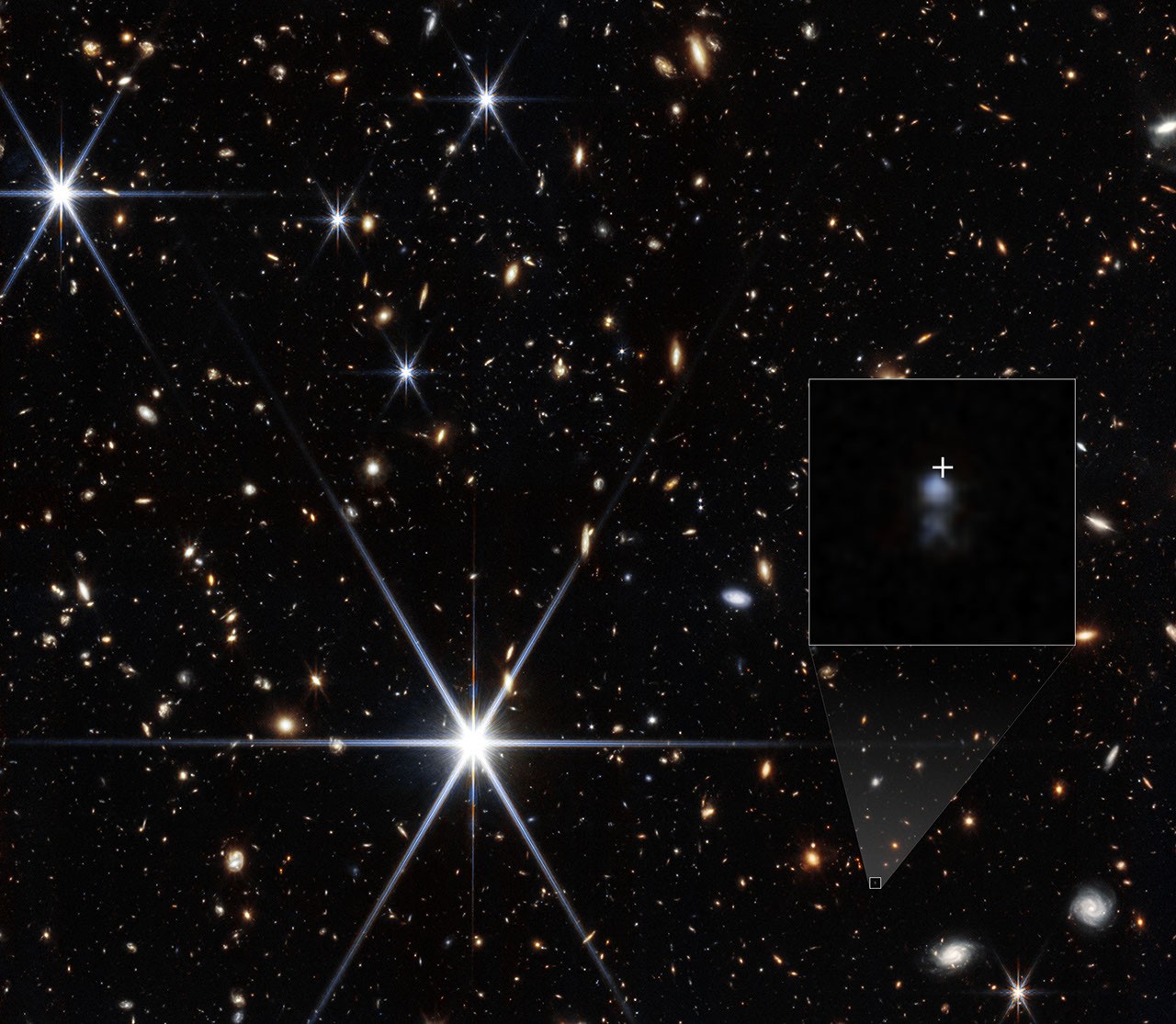
Webb Telescope Detects Farthest Fast Radio Burst, Shedding Light on Early Universe
The cosmos has once again revealed a stunning cosmic mystery, as astronomers have utilized the powerful capabilities of the James Webb Space Telescope (JWST) to measure the distance to the most remote Fast Radio Burst (FRB) ever detected. These fleeting, yet incredibly energetic, cosmic signals are providing astronomers with a unique window into the universe's distant past, offering clues about its formation and evolution.
What Happened?
Fast Radio Bursts are enigmatic, millisecond-long flashes of radio waves that originate from billions of light-years away. While their exact cause remains a subject of intense scientific investigation, they are believed to be associated with extreme astrophysical events. The recent breakthrough, detailed in reports from NASA and scientific publications, involves the JWST precisely measuring the distance to a previously detected FRB. This measurement places the origin of this particular burst at an astonishing distance, allowing scientists to study it as it existed when the universe was only about 3 billion years old, a mere fraction of its current age of approximately 13.8 billion years.
Why Does This Matter?
The ability to measure the distance to such an ancient FRB is a significant achievement for several reasons. Firstly, it confirms that these powerful radio emissions were present and detectable even in the very early stages of the universe's evolution. This implies that the phenomena responsible for generating FRBs were active when the universe was young and vastly different from what we observe today. Secondly, by pinpointing the distance, astronomers can better understand the characteristics of the host galaxy and the cosmic environment surrounding the FRB's origin. This data is crucial for testing theories about what generates FRBs, such as highly magnetized neutron stars (magnetars) or potentially more exotic phenomena.
"This measurement is a testament to the Webb telescope's extraordinary capabilities and its potential to revolutionize our understanding of the early universe."
- Adapted from NASA Science (.gov)
Background Context: The Mystery of Fast Radio Bursts
FRBs first captured the scientific community's attention in 2007 with the discovery of the first repeating FRB. Since then, numerous FRBs have been detected, with a significant portion being one-off events, making them even harder to study. The challenge has always been twofold: detecting these brief flashes and then pinpointing their precise location in the vastness of space. Early efforts often struggled to associate an FRB with a specific host galaxy, leaving their origins shrouded in mystery. The development of more sensitive radio telescopes and, now, the power of the JWST to conduct follow-up observations, have been pivotal in overcoming these challenges.
Key questions surrounding FRBs include:
- What astrophysical objects or events produce these bursts?
- Are FRBs predominantly caused by magnetars, or are there other contributing factors?
- How common are FRBs throughout cosmic history?
- Can FRBs be used as cosmological probes to study the intergalactic medium or the expansion of the universe?
What to Expect Next
The detection of this distant FRB is likely just the beginning. With the JWST and other advanced observatories continuing to scan the skies, astronomers anticipate detecting and characterizing even more FRBs at extreme distances. Future research will focus on:
- Increasing the sample size of distant FRBs to build more robust statistical models.
- Correlating FRB properties with the characteristics of their host galaxies and environments in the early universe.
- Refining theoretical models for FRB generation based on new observational data.
- Potentially using FRBs as 'cosmic lighthouses' to probe the cosmic web and the distribution of matter in the universe's early epochs.
The ongoing exploration of Fast Radio Bursts, now significantly enhanced by the capabilities of the James Webb Space Telescope, promises to unveil more secrets about the universe's most energetic phenomena and its formative years. Each new detection and measurement brings us closer to solving one of modern astronomy's most captivating puzzles.